

AI in Search Engines: How AI is Transforming the Way We Find Information
This article explores how AI in search engines is transforming information retrieval by delivering context-aware, conversational answers and personalized results, highlighting key features, top tools, benefits, risks, and future trends.
 Krina Kumbhani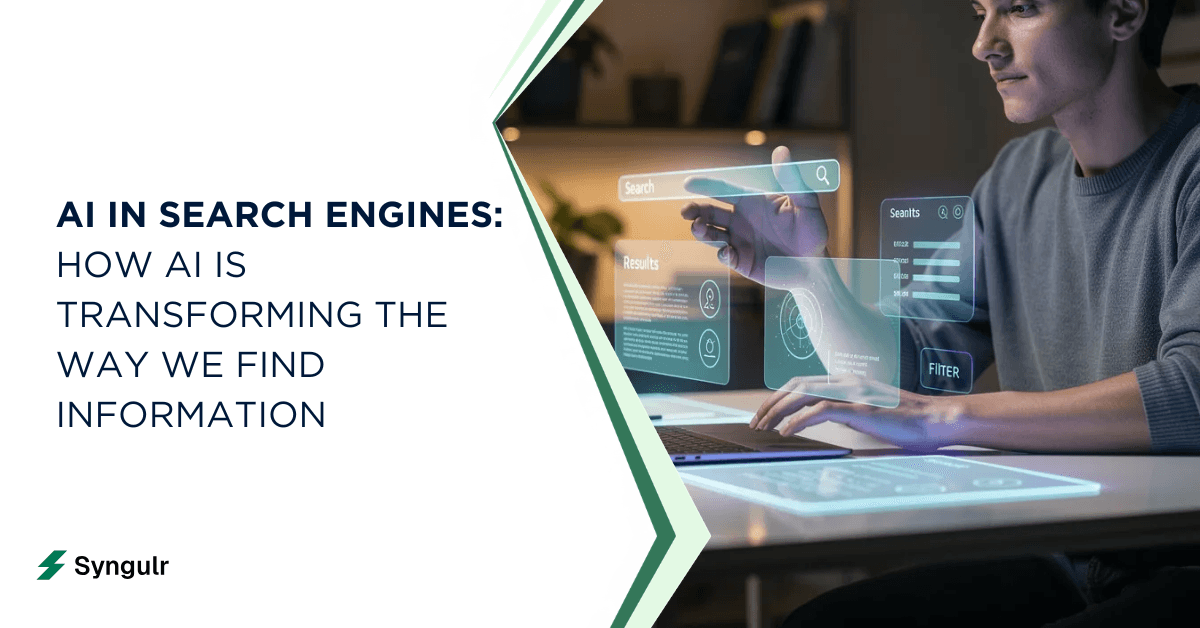
Introduction: From Blue Links to AI Answers
The era of ten blue links is fading. AI in search engines has reshaped how we find information, replacing static result pages with conversational answers, concise summaries, and direct answers pulled from multiple web sources. Instead of scanning dozens of tabs, many users now get synthesized responses at the top of the page.
This guide is designed for anyone interested in how AI is changing search—whether you're a casual web user, a business owner, or a technology enthusiast.
Modern ai-powered search engine platforms do more than match keywords. They interpret context, analyze user intent, and handle follow up questions without forcing you to start over. AI search engines use advanced algorithms for context and intent analysis, which means they can handle complex, conversational queries effectively.
Throughout this article, you'll see terms like ai search engines, ai search, ai driven search, and ai assisted search used to describe this shift. These are distinct from classic google search, which relied on keyword matching and link-based ranking. The difference matters because search engine artificial intelligence changes not just results, but how you interact with the search experience itself.
We'll cover what AI search actually is, how search engine artificial intelligence works under the hood, which tools rank among the best ai search engines today, and what risks you should watch for.
What Is an AI Search Engine?
An ai search engine is a system that uses large language models, semantic search, and ranking algorithms to generate direct answers instead of only returning links.
Before diving into their differences, it's important to define two key terms:
- Keyword-based indexing: This is the process traditional search engines use to organize and retrieve information. They scan web pages and create an index based on the exact words (keywords) found in the content. When you enter a query, the engine matches your keywords against this index to return relevant links.
- Semantic search: AI search engines utilize vector embeddings for semantic search capabilities. Semantic search goes beyond matching exact words; it analyzes the meaning and context of your query to understand your intent. By converting both queries and content into mathematical representations (vectors), AI can find results that are contextually relevant, even if the exact keywords don't match.
Unlike traditional search engines, which rely on keyword-based indexing and signals like backlinks, ai search engines analyze context and intent for better results.
Traditional search engines match your exact words against an index. Ai based search understands natural language queries, figures out what you actually mean, and maintains context across a conversation. If you ask "best CRM for nonprofits" and follow up with "what about free plans?", the engine knows you're still talking about CRMs.
These tools sit between ai chatbots and classic search. They're optimized for information retrieval and delivering relevant results, not just open-ended conversation. Examples include Perplexity AI, brave search, google ai mode (powered by Gemini), and microsoft copilot, each representing a different approach among ai-driven search engines.
Terms like searching ai and ai searcher refer to the user-facing side of this technology. Smart search engines is a broader label covering any engine with advanced ai features. Website search ai refers to embedded search systems inside specific sites and apps, helping users easily explore documentation, product catalogs, or help centers.
How AI Search Engines Work Under the Hood
Understanding how ai search engines work requires looking at several technical layers that go beyond traditional search.
Crawling and indexing still happen, but modern systems also create semantic representations of content. AI search engines use vector embeddings for semantic understanding, capturing meaning rather than just matching strings. When you type a query, it's converted into a vector and compared against indexed content using semantic search or hybrid methods that mix keyword and embedding retrieval.
Next comes Retrieval-Augmented Generation (RAG). This is the mechanism behind many ai power search engine experiences: the system retrieves relevant documents, then passes them as context to a large language models-based generator. The result is a synthesized answer with citations, not a hallucinated guess. Natural language processing allows AI to comprehend complex queries better, and AI search engines provide real-time updates by integrating with APIs that pull fresh data sources.
Practical components include transformer models for embedding generation and answer synthesis, neural rerankers for quality, and ranking signals like freshness, authority, and user behavior. AI search engines utilize vector embeddings for semantic search capabilities, which is why results feel more relevant than old-school keyword matching. AI systems can filter out low-quality content and prioritize authoritative sources, ensuring you see reliable results rather than spam.
Key Features of Modern AI Search
Several key features distinguish search engines with ai from their predecessors. Here's what sets them apart.
Conversational answers are the most visible difference. AI search engines can handle complex conversational queries, supporting follow up questions and query refinement. Context tracking allows iterative search refinement without restarting, so the engine remembers earlier parts of your session. This makes the ai search experience feel like a dialogue, not a series of disconnected searches.
Citations and source transparency matter. AI search engines summarize information and generate citations for accuracy, letting you verify claims through clickable links to reputable sources. This is essential for building trust, especially when dealing with complex questions in healthcare, finance, or legal topics.
Multimodal search capabilities allow input through images and voice, not just text. Google's AI Mode, for example, lets you snap a photo or use voice search alongside typed natural language queries. AI search engines summarize information and provide citations across all these input types, giving you accurate responses regardless of how you ask.
Many ai driven search engines also offer advanced features like deep summarization, topic overviews, and export options (PDF, shareable links) for research workflows. These ai tools for search go well beyond quick summaries, producing actionable insights organized into sections. Personalized responses adapt to your preferences, ecosystem, and search history when privacy settings allow.
Google Search, AI Mode, and the Google Ecosystem
Google search has evolved from pure keyword results to ai overviews and google ai mode powered by Gemini. Google's AI Mode allows follow-up questions in a conversational format, letting users ask complex queries and get synthesized responses with relevant links.
In practice, users open an AI tab, type or speak a question, and receive organized answers drawn from multiple ai models and web sources. The system supports conversational queries, multimodal input, and integration with the broader google ecosystem including Maps, YouTube, Gmail, and Workspace. This makes it easy to ask something like "what's my schedule tomorrow and where's a good lunch spot nearby?" and get a personalized, multi-source answer.
Limitations remain. AI overviews sometimes misrepresent facts, and many users can't distinguish between standard search results and AI-generated content. AI-generated summaries can decrease traditional website clicks, which is a concern for publishers. According to research, users are less likely to click on links when an AI summary appears in search results.
Despite Google's dominance, many users still try other ai search engines for specialized or privacy-focused use cases. Some actively seek platforms that let them toggle AI summaries on or off, reflecting mixed feelings about the new search features.
Brave Search and Independent AI Indices
Brave search stands out as a privacy-focused engine with its own independent index, not just a wrapper around Google or Bing. Brave Search provides AI summaries without tracking user data, making it a strong choice for users who prioritize user privacy.
Brave's approach is hybrid: traditional results appear alongside an AI answer at the top, with clear citations and optional follow-up questions. Its summarizer handles roughly 15 million AI answers per day, covering about a quarter of all Brave Search queries. Users can also customize rankings using community-built filters, adding a layer of transparency that larger engines don't offer.
Compared to google ai mode, Brave's ai driven search experience may have slightly narrower coverage but delivers stronger privacy guarantees and a straightforward design. Fewer ads, no profiling, and clearer source attribution make Brave a favorite for users who want an ai-powered search engine without surveillance.
Deep Research and Long-Form AI Search
Deep research is a mode available in some ai search engines like Perplexity AI, ChatGPT, and Claude that produces multi-page reports using dozens or hundreds of sources. Unlike quick summaries that return in seconds, deep research often takes 30 to 120 seconds as the system retrieves, ranks, and synthesizes information across a wide range of data sources.
Perplexity offers real-time web results with AI-generated answers, making it especially useful for tasks like market analysis, scientific literature reviews, or competitive landscape reports. Imagine preparing a white paper on AI adoption in finance: deep research mode delivers sections on regulatory concerns, case studies, statistics, and cited answers, all exportable to PDF or Word.
This is where ai driven search plus RAG truly shines. Instead of opening dozens of tabs and manually taking notes, you get a synthesized brief with up to date information. For academic work, tools like Consensus summarize and cite academic papers effectively, giving researchers a fast path to relevant information across multiple languages.
Website Search AI: Bringing AI Search to Your Own Site
Website search ai refers to embedding ai tools for search directly into a company's site or app. This transforms basic keyword site search into an intelligent system that understands synonyms, product attributes, and user intent.
In ecommerce, ai for searching products means shoppers can type "rugged budget smartphones under $300" and get filtered, relevant results instead of a generic list. In SaaS documentation, ai based search helps users find answers by understanding context across product versions and related topics. For internal knowledge bases, smart search engines let employees ask plain-English questions and get synthesized answers from help tickets, policy docs, and project files.
Many vendors now offer APIs and SDKs so developers can integrate vector search and LLM-powered retrieval into a custom version of their search experience. Implementation considerations include privacy (on-device vs cloud), cost per query, and latency requirements.
Best AI Search Engines: How to Evaluate Options
The best ai search engine depends entirely on your use case. A researcher needs citation quality and access to academic papers. A shopper needs speed and product relevance. A privacy-conscious user needs minimal tracking.
Key evaluation criteria include answer accuracy, citation quality, speed, privacy policy, pricing (free plan vs premium plans), and depth of ai assisted search features. All-purpose engines like google ai mode or Perplexity AI deliver fast, broad coverage. Niche tools specialize in deeper content with stricter data handling, such as Consensus for academic work or microsoft copilot for tasks within the microsoft ecosystem.
Tradeoffs are real. Broader coverage sometimes means less transparency. Privacy-focused tools may sacrifice some freshness. Accuracy and transparency in AI responses remain critical concerns across all platforms, so testing multiple tools with the same search queries is the most practical way to compare. Try queries like "latest treatment guidelines 2026" or "features comparison between two CRM platforms" and evaluate how each engine handles concise summaries, cited answers, and conversational results.
Use Cases: Web, E-commerce, Customer Support, and Beyond
On the web, search engines with ai handle mixed intents and complex problems that traditional search struggled with. A user asking "best mid-range running shoe for pronation under $100" gets product suggestions, comparisons, and user reviews synthesized into one response, helping them easily explore options in a conversational way.
In ecommerce, ai power search engine technology enables attribute-level filtering, alternative suggestions, and intent-aware ranking. Shoppers find what they need faster, which means higher conversion and less cart abandonment.
Customer support portals benefit from ai searcher capabilities that surface precise answers from help docs, past tickets, and known issues. Instead of wading through FAQs, users enter natural language questions and receive quick summaries or detailed guides. Other domains like healthcare information lookup, technical documentation, and enterprise internal search also benefit, as long as the system delivers reliable results with proper source verification.
Benefits and Risks of AI in Search Engines
The benefits are clear. AI-powered search engine technology delivers faster answers, better relevance, and personalization tuned to individual context. Users succeed more often with complex queries, and features like code generation, voice search, and multimodal input expand what's possible. AI search technology is evolving rapidly, enhancing user experiences across every domain.
However, risks deserve equal attention. Hallucinations remain an issue, where large language models invent facts that sound plausible. Biased training data can skew framing. AI search engines may threaten traditional website traffic and revenue models, as changes in search dynamics focus on citations rather than traditional rankings. Over-reliance on synthesized answers can erode critical thinking.
Surveys reflect this tension. Only about 6% of U.S. adults trust AI summaries "a lot," and over half of consumers want the option to toggle them off. Responsible practice includes transparent citations, clear disclaimers, and user controls over personalization and new features. Always verify AI answers via cited links, especially for health, finance, or legal decisions.
Future of AI-Driven Search
Through 2026 and beyond, ai driven search engines will push deeper into personalization, integrating user history and context from productivity tools and other platforms. Multimodal understanding will expand, combining text, images, video, and even live environment inputs into a single next generation search experience.
The line between chatbots and ai search engines will continue to blur. Users will interact with a single assistant that retrieves information, completes tasks like booking flights or drafting emails, and delivers personalized responses, all within one interface. Privacy-preserving search will grow through on-device models and federated learning, giving users more control.
AI search engines are expected to improve accuracy and personalization as models mature. For businesses, search engine optimization will evolve toward "Answer Engine Optimization," where content must be structured for embeddings, carry strong authority signals, and remain fresh. AI in search engines is becoming a baseline expectation, not an experimental add-on. The competitive differentiators will be accuracy, privacy, advanced capabilities, and domain specialization.
Conclusion: Choosing the Right AI Search Experience for You
AI in search engines is now a core part of how we find information. From general-purpose ai-powered search engine tools like Google AI Mode and Perplexity to specialized website search ai and enterprise solutions, the options span every need and premium features level.
The best approach is practical: try multiple smart search engines and ai based search workflows with your own real queries. Compare how each handles unstructured data, delivers relevant information, and supports follow-up exploration across multiple ai models.
Treat AI as an ai assisted search partner. It's fast, powerful, and getting better every month. But it still requires human judgment, especially for critical decisions. Use the cited answers, cross-check key information, and stay curious about the tools reshaping how we all search.
Related articles
Build your AI workforce today
Put everything you just read into practice. Spin up AI employees for your business in minutes — no credit card required to start.