

Artificial Intelligence in Social Media: The Complete 2026 Guide for Marketers
This comprehensive 2026 guide explores how artificial intelligence in social media is transforming marketing strategies through automated content creation, advanced ad targeting, and enhanced customer engagement, empowering brands to achieve faster growth and deeper audience insights.
 Krina Kumbhani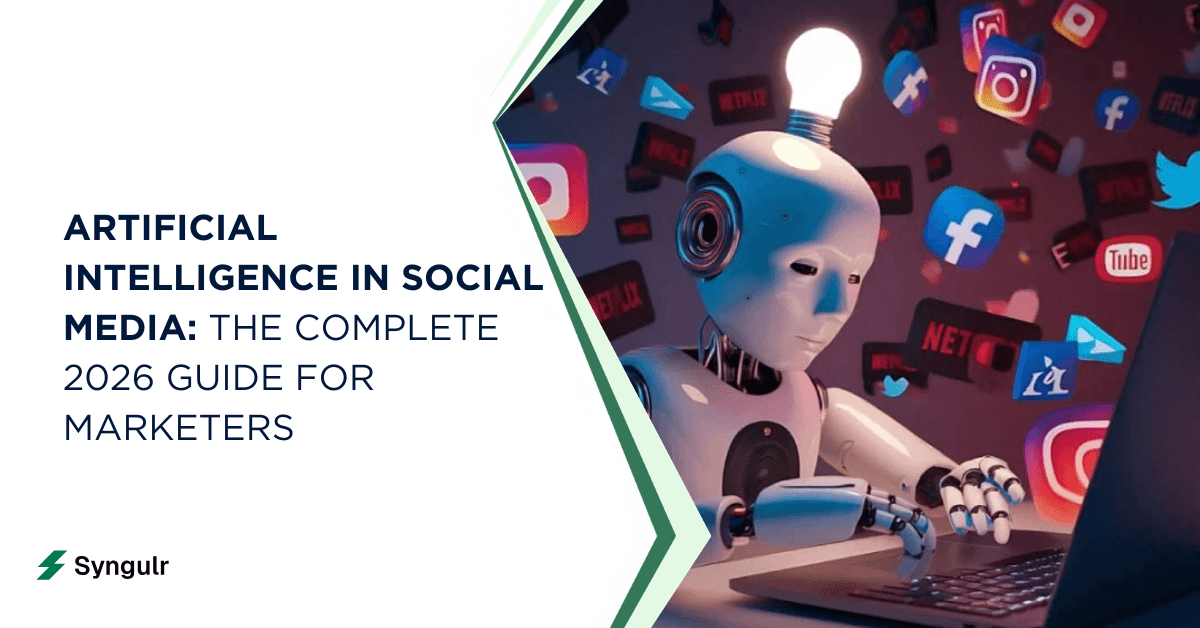
Introduction: Why Artificial Intelligence in Social Media Matters Right Now
Between 2020 and 2025, artificial intelligence in social media went from a nice-to-have experiment to a non-negotiable layer of digital marketing. TikTok's explosive growth, the rise of Instagram Reels, and the launch of YouTube Shorts created enormous pressure to produce more content, faster, across more social media platforms. Artificial intelligence is reshaping social media by automating content creation, sharpening ad targeting, and scaling customer engagement in ways that simply weren't possible with manual workflows alone.
In plain terms, AI in social media refers to machine learning, natural language processing, and computer vision systems working behind the scenes to rank feeds, serve ads, moderate content, and generate creative assets. These systems power everything visible (chatbots, AI filters, auto-captions) and invisible (algorithmic recommendations, fraud detection, sentiment analysis).
AI automates content creation, analyzes user behavior to deliver tailored content, and assists in generating engaging content including images and videos. This means marketers can produce high-quality content in seconds, automate repetitive processes, and save significant time while maintaining relevance and engagement.
The core promise for marketers is straightforward: faster content creation, sharper ad targeting, and scalable customer engagement. But results only follow when you pair AI tools with clear social media marketing strategy and human oversight. Brands using AI are 1.6x more likely to see engagement growth, which makes the case for adoption hard to ignore.
This guide covers everything from understanding artificial intelligence social media marketing to choosing the right AI tools and using AI for social media marketing without losing brand voice or trust. We'll walk through organic and paid use cases, from ai social media advertising to AI-powered customer service, with real brand examples and concrete tools.
What Is AI in Social Media Marketing? Core Concepts & Use Cases
AI in social media marketing combines algorithms, user data, and automation to power everything from feed recommendations to ad delivery. At its core, social media marketing artificial intelligence relies on three building blocks:
- Machine learning - algorithms that improve through data, powering feed ranking and predictive analytics
- Natural language processing - the technology behind auto-captions, chatbots, and sentiment analysis
- Computer vision - face recognition in photos, object detection, and visual content moderation
Key Definitions in AI-Powered Social Media Marketing
- AI-generated content: Content such as text, images, or videos that is created by artificial intelligence systems rather than humans. AI-generated content can be produced in seconds, automating content creation processes and saving marketers time while maintaining quality and relevance. This includes everything from social media captions to full-length videos, tailored to specific audience segments.
- Predictive analytics: The use of AI and machine learning algorithms to analyze historical and real-time user data in order to forecast future trends, behaviors, or outcomes. In social media marketing, predictive analytics helps optimize content relevance, ad targeting, and campaign performance by anticipating what will resonate with audiences.
- Generative AI: A subset of artificial intelligence focused on creating new content, such as images, videos, or text, based on input data or prompts. Generative AI assists in producing engaging content, including images and videos, making content production faster and more scalable for marketers.
These building blocks create two layers of AI. Visible AI includes chatbots, AI filters, auto-captions, and generative AI tool outputs. Invisible AI covers newsfeed algorithms, fraud detection, and audience segmentation running silently beneath the surface.
AI tools enhance social media marketing through predictive analytics and support a wide range of task categories:
- Content production and content creation (captions, video scripts, visuals)
- Ad targeting and optimization (real-time bidding, lookalike audiences)
- Social listening and sentiment analysis (tracking brand perception across digital channels)
- Customer engagement (chatbot triage, comment management)
- Content moderation and brand compliance
- Creative testing and performance prediction
AI can analyze user data to optimize content relevance, and AI can generate high-quality content in seconds. Brands that understand the ai in social media market early gain an edge in personalization, measurement, and creative testing.
How AI Works Across the Social Media Marketing Workflow
Think of the AI social workflow as a continuous loop: research → planning → creation → publishing → optimization → reporting. At each stage, machine learning algorithms, generative AI, and predictive analytics play specific roles.
Research: Surfacing Trends and Insights
AI surfaces trending topics, identifies emerging trends, and analyzes conversations happening across social channels to fuel brainstorming content ideas.
Planning: Optimizing Timing and Formats
AI suggests optimal posting times, formats, and post suggestions based on historical audience behavior and platform-specific data.
Creation: Generating Content Efficiently
Generative AI drafts captions, scripts, and visual assets. An AI writing assistant can produce first drafts of LinkedIn posts, carousels, and social posts in minutes.
Publishing: Automating Distribution
Scheduling tools auto-publish, run A/B tests, and distribute across channels.
Optimization: Enhancing Performance
AI systems detect creative fatigue, shift ad spend, and reallocate budgets toward top performers.
Reporting: Delivering Actionable Insights
Dashboards powered by predictive analytics forecast future performance and deliver data-driven insights.
AI can reduce manual effort in social media marketing by automating routine tasks and repetitive tasks like scheduling and reporting. These data loops feed engagement signals back into recommendation systems, making forecasts more accurate over time.
Agentic AI (autonomous agents that plan, post, and iterate) is emerging, but full automation still needs human guardrails. Treat AI as an assistant that requires oversight, not a replacement for strategic thinking.
AI for Social Content Creation & Production (Without Losing Brand Voice)
Content creation workloads have exploded. Reels, TikTok, Shorts, and multichannel posting mean social media marketers need to create content at a pace that's impossible without AI-driven tools.
Generative AI in Content Production
Generative AI assists in creating engaging content including images and videos, making content production faster and more scalable. Tools like ChatGPT, Claude, Jasper, and Writesonic help produce first drafts for captions, hooks, carousels, scripts, and blog-to-social repurposing. AI tools can automate content creation processes, and AI can automate content creation, saving marketers time. AI can produce content tailored to specific audience segments, which means a single brief can generate multiple variants for different platforms and audiences.
Maintaining Brand Voice with AI
However, AI generated content risks losing brand voice authenticity if you don't set clear boundaries. Here's how to protect your brand voice:
- Feed style guides, tone examples, and banned phrases directly into AI prompts.
- Regularly update voice profiles as your brand evolves.
- Always run human edits before publishing.
A practical workflow looks like this: write long-form content → use a generative AI tool to generate 10 platform-specific social media posts → a human editor refines for nuance, compliance, and brand fit.
For visuals, tools like Canva AI, Adobe Firefly, Midjourney, Runway, and HeyGen create thumbnails, B-roll, and short-form video that match your visual identity.
When using AI for social media marketing, treat tools as junior creatives that need clear briefs, feedback loops, and quality checks before anything goes live.
Prompt Engineering: Getting High-Quality Social Posts from Generative AI
Good outputs from generative AI depend more on the prompt than the model itself. A vague prompt produces generic content. A structured prompt produces relevant content that sounds like your brand.
Use this repeatable prompt framework for social content:
| Element | What to Include |
|---|---|
| Audience | Demographics, interests, pain points |
| Objective | Awareness, clicks, conversions, engagement |
| Platform | Instagram, LinkedIn, TikTok, X |
| Brand voice | Tone descriptors, example phrases |
| Format | Carousel, caption, thread, script |
| Constraints | Word count, emojis, hashtags, CTA style |
Here are three concrete prompt examples:
- Instagram Reel caption: "Write 3 caption options for a 30-second Reel about [product]. Audience: millennial parents. Tone: warm, witty. Include one CTA and 3 hashtags. Max 150 characters."
- LinkedIn post: "Draft a thought-leadership post about artificial intelligence social media marketing trends for CMOs. Tone: authoritative but approachable. 200 words. End with a question."
- X thread: "Create a 5-tweet thread explaining [topic] for small business owners. Conversational tone. Each tweet under 280 characters."
The iterative process matters: ask AI for 5 options, pick 1–2, then refine tone. Build a shared prompt library so your team reuses high-performing prompts for faster, consistent content ideas across campaigns.
AI-Powered Social Media Management Tools & Platforms
Social media marketers now choose from dozens of AI tools for scheduling, analytics, social listening, and community management. The sheer number of options makes consolidation essential; spreading across too many tools creates data silos and wasted budget.
A typical AI social suite in 2025 includes:
- Post drafting with brand voice matching
- Best-time-to-post suggestions based on real time audience insights
- A/B creative testing for captions and visuals
- Automated reporting dashboards
- Sentiment analysis across mentions and DMs
- Inbox triage by urgency and topic
When evaluating platforms, consider scheduling tools with AI features (similar to Buffer or Hootsuite's OwlyWriter), listening platforms (like Sprout Social or Brandwatch), and creative assistants (like Jasper or Predis.ai). AI helps in content moderation by automatically detecting and removing inappropriate content, which is built into most enterprise suites.
Choosing the right AI platform comes down to several factors:
- Channel coverage: Does it support Meta, TikTok, YouTube, LinkedIn, Pinterest?
- Integrations: Can it connect to your CRM, analytics, and ad accounts?
- Data ownership: Who owns the raw data and audience insights?
- Pricing and roadmap: Are AI features included or add-on?
There's also a meaningful difference between narrow point solutions (caption generators, hashtag tools) and integrated suites that combine planning, content production, and measurement. Successful ai in social media marketing depends on choosing a stack that matches your team's workflow without creating tool sprawl.
Ad Targeting & Optimization: AI in Social Media Advertising
AI social media advertising is now built directly into major platforms. Meta Advantage+, Google Performance Max, TikTok Smart Performance Campaigns, and LinkedIn predictive audiences all use AI to find high-intent users and allocate budgets automatically.
Here's how AI-enhanced ad targeting works in practice:
- Lookalike modeling: AI identifies users who resemble your best customers
- Real-time bidding: Machine learning algorithms adjust bids millisecond by millisecond
- Creative variant testing: AI rotates headlines, images, and CTAs to find winning combinations
- Budget shifting: Algorithms move ad spend toward top-performing ad campaigns based on live signals
AI can enhance advertising performance by optimizing bidding strategies and targeting. AI can optimize ad targeting based on user behavior, and AI tools can analyze user behavior to optimize ad targeting further. Brands using AI for ads see 32% higher ROAS compared to manually managed campaigns.
AI can predict ad performance before launch, and AI tools can automate campaign optimization across multiple platforms simultaneously. AI can automate the creation of dynamic social ads based on user preferences, while AI-driven personalized ads improve user engagement significantly.
Real results back this up. One direct-to-consumer brand spending $2M/month on Meta used AI-driven creative testing to achieve 54% higher ROAS and 28% lower CPMs. Another e-commerce brand reduced CPA by 42% and hit 4.6× ROAS in just three weeks using AI generated ads.
Marketers should still set audience guardrails, creative constraints, frequency caps, and conversion goals. Over-broad automation risks creative fatigue and overspending on easy clicks. Run weekly human reviews of AI-driven campaigns.
Personalization, Recommendations & AI Filters on Social Platforms
Recommendation engines like TikTok's "For You" page, Instagram Explore, and YouTube Home use AI to personalize feeds at the individual level. Personalized content recommendations keep users engaged on social platforms, and this personalization AI sets user expectations for curated experiences.
Marketers can align with these algorithms by:
- Posting natively in each platform's preferred format
- Optimizing for watch time and saves, not just likes
- Testing hooks in the first 1–3 seconds
- Treating every piece as "recommended content" rather than pure follower content
AI filters (Snapchat Lenses, Instagram AR filters, TikTok effects) serve double duty: they drive creative trends and offer branded experiences for product launches and campaigns.
AI-driven personalization can increase conversion rates by 26%. AI enables hyper-personalization of content at scale, and AI analyzes user behavior to deliver tailored content. AI can increase conversion rates by up to 26% through predictive personalization, and AI-driven personalization can boost conversion rates by 26%.
The connection between organic and paid is critical: organic behavior data feeds into paid audience modeling, enabling more granular segmentation and remarketing. Hyper-personalized feeds are a key output of artificial intelligence in social media, and they set user expectations for curated experiences and custom AI filters across every social channel.
AI for Customer Engagement, Social Care & Community Management
Customer engagement on social media now spans replies, DMs, comments, reviews, and UGC interactions. Volume has grown across all social media platforms, and the expectation for instant responses has never been higher.
AI inbox tools triage messages by sentiment, urgency, topic, and intent (support vs. sales), routing messages to humans or AI chatbots accordingly. AI chatbots provide 24/7 customer support on social media across Messenger, WhatsApp, Instagram DMs, and web chat.
Chatbots can handle a wide variety of customer inquiries, from FAQs and order tracking to simple pre-sales qualification. AI chatbots improve customer satisfaction by providing instant responses, and chatbots learn from user interactions to enhance responses over time. AI chatbots free human agents for complex customer issues that require empathy, judgment, or escalation authority.
Brands like Sephora (with its Ora chatbot on Messenger) demonstrate how AI for customer engagement on social media can deliver 24/7 assistance, personalization, and meaningful improvements in response times.
However, risks exist with fully automated customer engagement:
- Tone mismatch: AI may not match the emotional context of a frustrated customer
- Hallucinations: Chatbots can generate inaccurate information
- Trust erosion: Customers may feel dismissed if they can't reach a human
Always maintain clear policies, disclaimers, and human override options for customer-facing AI.
Social Listening, Sentiment Analysis & Market Intelligence with AI
Social listening has evolved far beyond simple keyword tracking. AI-driven social listening transforms conversations into actionable insights by using NLP models that tag mentions by sentiment (positive, negative, neutral), topic (pricing, features, service), and emotion (anger, delight, confusion).
This analysis runs across X, Reddit, TikTok comments, reviews, and forums, giving brands a real-time view of brand perception across the internet. AI tools are used for social listening and sentiment analysis to monitor brand health, and these capabilities help social media marketers analyze data at a scale no human team could match.
AI can surface trending topics before they peak, and AI can predict trending topics before they peak, giving brands a window to act on relevant discussions before competitors do. AI can help brands identify emerging trends in content, which supports both organic content strategy and paid campaign planning.
Here's how this supports marketing strategy:
- Identifying product issues early before they escalate
- Mapping competitor weaknesses through analyze conversations
- Discovering new content angles or influencer marketing opportunities
Consider a practical example: a brand detects a rising complaint theme around shipping delays on Reddit. By catching the pattern early, the team adjusts both operations and messaging proactively, turning a potential crisis into a demonstration of responsiveness. Enterprise listening tools powered by AI (such as Brandwatch, Talkwalker, or similar platforms) make this kind of market intelligence accessible.
AI for Influencer Marketing, Creators & Virtual Influencers
Artificial intelligence in social media is fundamentally reshaping influencer marketing from discovery through measurement. Manual influencer vetting is slow and subjective. AI changes this by scanning creator audiences for demographics, fake follower patterns, engagement authenticity, and content themes to shortlist ideal partners.
AI can analyze audience behavior in real-time, which makes it possible to evaluate whether an influencer's audience genuinely matches your target audience. Predictive modeling estimates likely performance (reach, clicks, conversions) for each influencer and helps set fair pricing and realistic KPIs.
Virtual or AI-generated influencers (like Lil Miquela and brand-owned avatars) introduce new possibilities:
- Pros: Full brand safety, 24/7 availability, complete creative control
- Cons: Authenticity questions, disclosure requirements, consumer skepticism
The rise of virtual influencers raises questions about transparency and trust. Platforms like TikTok are already addressing AI-generated spam and working to help users distinguish authentic content from synthetic material.
Practical steps for leveraging AI in influencer marketing:
- Use AI to narrow candidate lists based on audience fit and engagement quality
- Let predictive models forecast campaign outcomes before committing budget
- Layer human review for brand fit, values alignment, and long-term relationship potential
Creative Intelligence: Testing, Predicting & Scaling High-Performing Content
Creative is now a primary performance lever for social media success. The difference between a campaign that delivers and one that wastes budget often comes down to which thumbnail, hook, or CTA was selected. AI helps test and iterate at a scale that manual processes can't match.
AI-driven creative analysis works by scoring thumbnails, hooks, video lengths, and CTAs against historical performance data. AI tools can predict audience engagement moments before they occur, enabling teams to launch with higher confidence and less guesswork.
Multivariate testing workflows powered by AI look like this:
- AI generates multiple creative combinations (visuals × captions × CTAs)
- Small-budget tests run simultaneously across audiences
- AI consolidates ad spend behind top-performing combinations
- Underperformers are paused automatically
Predictive creative intelligence reads early micro-signals like thumb-stop rate and comment velocity to forecast which creatives will scale. AI can increase engagement growth by 25% when creative testing is systematic rather than ad-hoc.
This ties directly to ai social media advertising and ai in social media marketing: creative testing and automated content production reduce waste and improve ROAS. One study found that AI-powered creative testing enabled 20× faster iteration compared to traditional workflows.
Risks, Ethics & Compliance: Using AI Responsibly in Social Media
Trust is fragile on social media, and aggressive AI use in public channels carries real reputational stakes. Effective use of AI requires balancing automation with human creativity and strategy. Rushing into full automation without guardrails is one of the fastest ways to damage brand equity.
Bias and Fairness
- Biased targeting: AI can perpetuate biases present in training data, leading to discriminatory ad delivery or content recommendations.
Transparency and Disclosure
- Deepfakes and misinformation: Synthetic media can be weaponized, and brands can be implicated unintentionally.
- Unlabeled synthetic content: 90% of consumers expect brands to disclose AI usage, and 65% of US adults feel uncomfortable with AI-generated ads.
Privacy and Data Protection
- Privacy concerns: Third-party data usage and tracking face increasing scrutiny.
Echo Chambers and Algorithmic Effects
- Echo chambers: Echo chambers can form as AI algorithms limit exposure to diverse viewpoints.
Internal Policy Recommendations
Emerging regulations matter. The EU AI Act, FTC guidance on endorsements and labeling, and platform-specific policies on political content and synthetic media are all tightening. Transparency about AI generated content builds consumer trust, while concealment erodes it.
Internal policies should include:
- Clear disclosure when content is generated or heavily assisted by AI
- Human review for every public reply or customer-facing message
- Restricted AI use in sensitive topics (health, finance, politics)
- Data driven decision making about which tasks warrant automation and which don't
Protecting your brand voice means setting AI guardrails, defining forbidden topics, and establishing escalation protocols when AI outputs are uncertain or off-brand.
Building an AI-First Social Media Strategy & Tech Stack
Tools alone don't guarantee results. Your social media strategy, workflows, and measurement frameworks must adapt around AI capabilities, not the other way around.
Here's a step-by-step approach to integrating AI into your marketing efforts:
- Audit your current workflow: Map every step from ideation to reporting.
- Identify bottlenecks: Determine where your team spends the most time. (Common answers: brainstorming content ideas, design iterations, reporting.)
- Choose 1–2 AI tools per bottleneck: Don't chase every new tool. Pilot deliberately.
- Document and standardize: Create SOPs, prompt libraries, and QA checklists.
- Scale what works: Expand AI adoption only after proving ROI in pilots.
Balance automation vs. control with a clear framework:
| Task Type | Automation Level | Examples |
|---|---|---|
| Fully automated | Scheduling, reporting, tagging | Buffer, analytics dashboards |
| Semi-automated | First-draft captions, ad creative variants | Jasper, ChatGPT |
| Always human-led | Strategy, crisis comms, brand positioning | CMO, social director |
Design a coherent AI platform stack by centralizing data, avoiding tool sprawl, and ensuring integrations among scheduling, analytics, CRM, and advertising systems. Combining AI capabilities across your stack eliminates data silos and makes marketing campaigns more cohesive.
Training teams is essential: AI literacy basics, prompt-writing skills, QA checklists, and "human in the loop" standards for compliance and quality. There's a steep learning curve at first, but structured onboarding accelerates AI adoption dramatically.
Real Brand Examples: AI in Social Media Marketing That Actually Works
Theory is useful. Results are better. Here are several real-world examples that show measurable impact from ai in social media marketing.
Heinz × DALL-E Ketchup Campaign
Heinz used DALL-E to generate AI images of "ketchup," and the results naturally resembled Heinz bottles. The campaign went viral, earning massive engagement and PR pickup, proving that AI-generated visuals can reinforce brand recognition when used creatively.
Ryan Reynolds × Mint Mobile × ChatGPT
Ryan Reynolds publicly used ChatGPT to write a Mint Mobile ad script "in his voice." The resulting video earned millions of views and significant earned media, positioning AI as a creative collaborator rather than a threat.
Sephora's Ora Chatbot
Sephora deployed its Ora chatbot on Messenger for 24/7 product assistance, personalized recommendations, and appointment booking. The result: faster response times, higher customer satisfaction, and reduced strain on human agents.
E-commerce AI Ad Performance
A mid-size e-commerce brand improved ROAS by 140% over 90 days using AI-driven campaign automation, smart bidding, and cross-channel budget optimization. In another case, an e-commerce brand using AI ad creatives reduced CPA by 42% and achieved 4.6× ROAS in three weeks, demonstrating the ad effectiveness that AI-powered campaigns can deliver.
Common Mistakes When Using AI for Social Media (and How to Avoid Them)
Rapid AI adoption in social media has led to predictable missteps. Here are the most common mistakes and how to fix them:
1. Over-automating replies
AI chatbots handling every message without human fallback leads to tone-deaf responses. Fix: Set escalation rules for negative sentiment, complex issues, or VIP customers.
2. Generic copy that erodes brand voice
Losing brand voice happens when teams accept AI first drafts without editing. Fix: Maintain a brand style guide inside every prompt and require human review before publishing.
3. Ignoring data privacy
Adding new AI integrations without privacy review creates compliance risk. Fix: Run a privacy and security review before connecting any new tool to your accounts or raw data.
4. Chasing every new AI tool without strategy
Tool overload fragments workflows and wastes budget. Fix: Evaluate tools against specific bottlenecks, not hype. One well-integrated AI platform beats five disconnected point solutions.
5. Neglecting creative differentiation
When everyone uses the same AI models with lazy prompts, social media posts start to look identical. Fix: Invest in unique data inputs, distinctive brand assets, and human creativity that AI can amplify rather than replace.
AI won't replace strategists. Human context and judgment remain critical for audience insight and long-term positioning. Incremental, well-governed AI adoption delivers fast wins without putting brand equity at risk.
Future Trends: Where AI in Social Media Marketing Is Heading by 2027
The next two to three years will reshape artificial intelligence social media marketing in fundamental ways. Here's what to expect:
Autonomous agent workflows
AI agents that can plan, execute, and optimize full marketing campaigns with minimal human input. These agentic systems will handle everything from ad creative rotation to budget allocation, though human-set guardrails will remain essential.
CRM + social data convergence
Deeper integration between CRM systems and social platforms will enable truly unified customer views, making data driven decision making more precise and personalization AI more effective across social media workflows.
AI-generated influencers go mainstream
Virtual influencers will move beyond novelty into standard marketing campaigns, raising new questions about disclosure, authenticity, and regulation.
AR/VR social experiences
Virtual reality and augmented reality features, powered by AI, will create immersive branded experiences. Meta's investments in VR social spaces and TikTok's expanding effects library point toward this future.
Algorithm evolution
Expect even more granular personalization, context-aware recommendations, and cross-device journey attribution. The ai in social media market will continue growing rapidly, intensifying competition and raising the bar for skill requirements.
Emerging regulation from the EU AI Act and FTC guidelines will force stricter labeling and transparency standards, making ethical AI adoption not just good practice but a legal requirement.
The bottom line: experiment now, set ethical standards early, and treat AI as a multiplier for creativity rather than a replacement for the humans behind your brand. Leveraging AI effectively means keeping your social media marketing strategy adaptive, your team skilled, and your brand's human voice firmly at the center. Start by auditing one bottleneck in your workflow, pilot one AI tool, and measure the results. That single step today puts you ahead of most teams still debating whether to start.
Related articles
AI Tools and Automation
Google AI Search: How AI Overviews and Search Labs Are Changing Google Search
Google AI Search blends web search with generative AI to deliver cited, synthesized answers through AI Overviews and AI Mode. Learn how it works, how to enable Search Labs on desktop and mobile, its real impact on SEO and traffic, and where AI-powered search is heading next in 2026.
AI Tools and Automation
Artificial Intelligence Code: Modern AI Coding Tools, Code Generation & Business Automation
AI-generated code has moved from novelty to the core of how teams ship software. Learn what artificial intelligence code is, how AI writes code from prompts, the top AI coding tools, when to trust it versus humans, and how Syngulr builds AI employees on AI-generated, human-reviewed code.
AI Tools and Automation
AI and Digitalization: How Artificial Intelligence Is Powering the Next Wave of Digital Transformation
Learn how AI and digitalization work together to reshape business operations, improve decision-making, and unlock measurable growth. A practical guide for leaders ready to drive effective digital transformation.
Build your AI workforce today
Put everything you just read into practice. Spin up AI employees for your business in minutes — no credit card required to start.