

Artificial Intelligence Code: Modern AI Coding Tools, Code Generation & Business Automation
AI-generated code has moved from novelty to the core of how teams ship software. Learn what artificial intelligence code is, how AI writes code from prompts, the top AI coding tools, when to trust it versus humans, and how Syngulr builds AI employees on AI-generated, human-reviewed code.
 Krina Kumbhani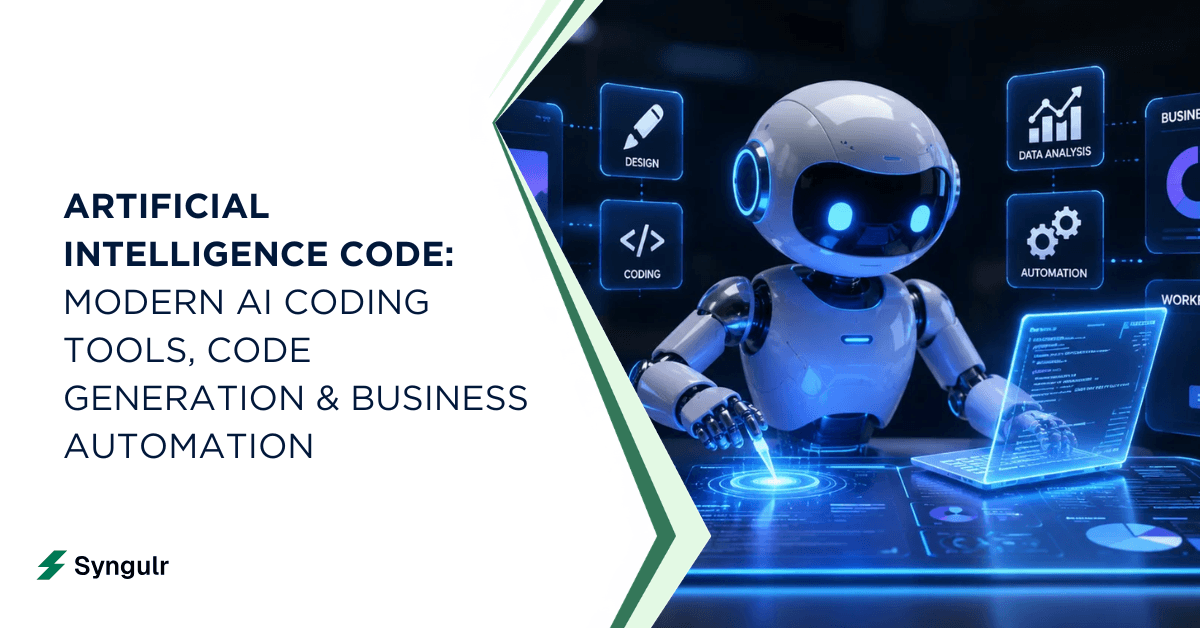
The way software gets built is changing fast. Artificial intelligence code-computer code produced, assisted, or optimized by AI systems-has moved from a novelty to a core part of how development teams ship products. If you're running a business that depends on automation, understanding how AI writes code (and how that code powers AI) is no longer optional.
What Is Artificial Intelligence Code?
Artificial intelligence code refers to source code that AI systems generate, suggest, or refine. AI code generation uses large language models trained on massive datasets of public repositories, documentation, and Q&A forums to produce code. These models use statistical patterns from training datasets to predict outcomes-essentially learning what "good code" looks like across millions of examples.
Code artificial intelligence captures the two-way relationship: AI that writes code, and code written to implement AI models. Artificial intelligence code enables machines to perform tasks requiring human-like intelligence, from classification to natural language understanding.
Here's how the key terms break down:
- Artificial intelligence for coding: uses deep learning and natural language processing to understand developer intent-far beyond traditional IDE autocomplete that only matches syntax
- Computer programming AI: models engineered to understand syntax, semantics, libraries, and APIs across various programming languages
- Generative AI code: executable source code produced from natural language prompts or partial specifications
- AI in code / AI in coding: the umbrella field covering all AI-assisted development, from code completion to debugging to deployment
At Syngulr, we see AI-written code as the foundation for our AI workforce platform. Our AI employees are themselves powered by AI-optimized source code-connectors, workflows, and integrations built with the help of ai code generation tools.
How AI Writes Code Today: From Prompts to Programs
When you type a prompt like "build a Python API for customer support tickets," a computer programming AI model parses your intent, maps it against patterns learned during training, and generates code tokens that satisfy both syntax and semantic constraints. AI code generation tools analyze natural language prompts to suggest code, and AI can generate code from natural language inputs across Python, JavaScript, Java, C#, Go, and more.
The scale is staggering: GitHub Copilot generated over 82 billion lines of code in its first year. AI tools can also provide step-by-step instructions for coding tasks, making the process transparent.
Here's the typical workflow:
- Prompt: developer writes a natural language description or partial spec
- Generate: AI produces code snippets, full functions, or multi-file scaffolds
- Review: human checks for correctness, coding style, and security
- Test: automated tests validate behavior
- Deploy: integrate into production via CI/CD pipelines
AI powered code generation tools run inside code editors like Visual Studio Code, JetBrains IDEs, command line interfaces, and browser-based environments-hooking directly into build and test systems.
Core Types of AI Coding Tools and Assistants
AI coding tools go well beyond autocomplete. They include debuggers, test generators, documentation writers, and refactoring engines. An ai coding assistant inside VS Code or a browser IDE can suggest code completion, explain errors, and edit multiple files simultaneously.
Key categories:
- IDE plugins: inline code suggestions, suggesting code snippets as you type (e.g., in Visual Studio Code)
- CLI tools: command line agents that modify files, run shell commands, and orchestrate deployments
- Browser IDEs: full development environments with built-in generative ai tools
- API-based generators: produce code based on API calls, useful for ai code generation software platforms
- Specialized assistants: tools focused on aws coding (CloudFormation, CDK, Terraform), data science, or enterprise security
AI coding tools can help identify security vulnerabilities in code and reduce coding errors by analyzing large code datasets. Some, like Tabnine, offer a "no-train-no-retain" policy for code privacy-critical for enterprise adoption.
AI Code Generation vs. Traditional Coding Workflows
Traditional coding means writing every line by hand. Artificial intelligence code generation automates the repetitive parts: boilerplate code, CRUD endpoints, test harnesses, migration scripts. AI code generation can automate repetitive coding tasks like boilerplate code, and it can save developers up to 30% of their coding time.
Generation coding workflows compress the cycle from requirements to running prototype. AI code generation can produce cleaner and more readable code when following established patterns.
Best for AI-generated code:
- REST/GraphQL API scaffolding and CRUD endpoints
- Data-processing pipelines and ETL jobs
- Unit and integration test suites
- Infrastructure-as-code templates (AWS CloudFormation, Terraform)
- Simple business automations: lead routing, email templating, scheduled reports
Best for human-crafted code:
- Security-sensitive auth flows, financial accounting logic
- Enterprise architecture decisions (microservices boundaries, fault tolerance)
- Performance-critical, low-latency systems
- Coding for artificial intelligence itself-training loops, model explainability, research code
- Complex integrations with unique compliance requirements
Business Impact: Productivity, Cost, and the AI Workforce
AI tools can automate repetitive coding tasks, enhancing productivity across development teams. AI coding assistants can produce code with fewer potential errors, and they help reduce the cognitive load on developers during coding. The result: AI code generation can speed up software release cycles significantly.
AI code generation can make coding more accessible for beginners, and AI-generated code can assist non-technical team members in development. AI tools help new developers learn programming languages faster, and they provide contextual guidance for new developers. This means AI tools can democratize coding for non-developers and business users.
Before AI coding: manual boilerplate, slow prototyping, engineers bottlenecked on repetitive tasks.
After AI coding:
- AI tools enhance collaboration by automating repetitive coding tasks
- AI coding assistants provide recommendations to reduce developer workload
- AI-generated code allows teams to focus on complex problem-solving
- Non-technical teams trigger small automations via natural language prompts
- Syngulr's AI employees automate support triage, CRM updates, and marketing ops with minimal manual coding
Key Use Cases: AI Coding Across the Software Lifecycle
Design phase:
- Generate pseudo-code and architecture outlines from natural language descriptions
- Create spec documents and data flow diagrams from requirements
Implementation phase:
- Inline code completion for faster feature development
- Generate integration code between CRMs, ERPs, and helpdesks
Testing phase:
- Auto-generate unit test suites for ticket-routing microservices
- Produce integration test harnesses for API endpoints
Operations & infrastructure:
- Generate aws coding templates: CloudFormation, CDK, or Terraform snippets for deploying AI agents into VPC-secure environments
- Scaffold CI/CD pipelines and deployment scripts
Legacy modernization:
- Translate legacy code (PHP, COBOL) to modern stacks
- Auto-generate migration scripts for database schema changes
Key components of AI code include data processing pipelines and model training loops. AI applications typically include phases of data preparation, training, and deployment, while monitoring and testing are crucial components of deploying AI applications. AI frameworks provide pre-built scaffolding for neural network architectures. TensorFlow is a widely used framework for building production-grade machine learning models, and Java is popular in enterprise environments due to strong scalability and type safety.
Syngulr Perspective: AI Employees Built on AI-Generated Code
Syngulr uses artificial intelligence code to construct specialized AI agents for sales, support, and operations. Each agent runs code generated and refined with AI assistance-connectors, workflows, and logic that tie into existing business tools.
- AI-written connectors let our AI digital workers integrate with CRMs, email suites, and analytics platforms using reliable, version-controlled source code
- Unlike generic platforms, Syngulr combines ai powered code generation tools with human-reviewed patterns, ensuring governance and security for business automation
- AI applications can integrate with external models via APIs to enhance functionality, and AI can automate tasks such as classification and prediction in software applications
- As generative AI code improves, Syngulr AI employees can self-upgrade their automations (with approvals), increasing value without massive re-coding projects
Working with Multiple Languages, Frameworks, and Clouds
Modern ai coding assistant tools must operate across multiple programming languages. Python is the dominant language for AI development due to its rich ecosystem. PyTorch is favored in research due to its flexibility and intuitive debugging. Scikit-learn is standard for traditional machine learning algorithms like clustering. Julia is designed for high-performance numerical analysis and computational science, while C++ is used when performance and low latency are critical in AI applications.
- Frontend: TypeScript/React component generation from design specs
- Backend: Java/Kotlin service scaffolding, Node.js webhook handlers
- Data: Python analytics consumers, ETL pipelines
- Infrastructure: aws coding for Lambda, Step Functions, S3 configurations with IAM best practices baked in
Code generators can produce both a Node.js endpoint and a Python consumer from a single prompt, then mix that application logic with infrastructure-as-code and CI/CD pipelines for reliable production deployment.
Best Practices and Risks: Using AI Safely in Production Code
AI code generation can boost code quality by following best practices, and ai coding tools can automatically refactor code to enhance maintainability. AI-generated code can help identify security vulnerabilities in real-time. However, overreliance creates risk-nearly half of AI-generated code contains security flaws according to industry reports.
Safeguards every team should implement:
- Human review: never auto-deploy artificial intelligence code generation outputs without oversight, especially for authentication, financial logic, and healthcare workflows
- Coding standards: enforce coding style, dependency policies, and security baselines that AI must follow
- Static analysis and scanning: combine ai code generation with linting, dependency scanning, and runtime monitoring
- Access control: limit agent privileges; isolate execution environments for ai coding agents
- Provenance tracking: log which parts of your codebase are AI-generated vs. human-written for audit trails and code reviews
- Governance ownership: assign a dedicated team to own review code processes for all ai assisted coding outputs
Prioritize code quality over speed. The fastest code isn't valuable if it introduces vulnerabilities or technical debt.
Choosing AI Coding Solutions for Your Organization
When evaluating ai coding tools, consider language coverage, IDE integration, security model, data retention policies, and fit with your existing CI/CD stack. A code assistant platform should support your chat interface workflows and reduce context switching for developers.
Practical rollout plan:
- Start with a pilot: automate one workflow (e.g., support escalation or sales follow-up) using AI-generated code snippets
- Measure results: track bug fixes, developer productivity gains, and time savings
- Expand gradually: move from single coding tasks to multi-file, cross-stack automations
- Combine tools: pair general-purpose ai code generators with Syngulr's AI workforce, where AI-written integrations directly power customer-facing and internal automations
- Govern continuously: maintain pair programming practices between humans and AI, enforce code optimization standards
AI models learn from data and can produce outputs such as recommendations or classifications-the same principle that powers both your coding workflow and your AI employees.
Glossary of AI Coding Terms
- Artificial intelligence code: computer code produced or refined by AI, especially machine learning models trained on source code corpora
- Code artificial intelligence: AI systems that reason about, analyze, or generate computer code
- Computer programming AI: models designed to understand and produce code across multiple programming languages
- AI in code: any application of artificial intelligence within the software development lifecycle
- Generative AI code: executable code produced from natural language prompts using generative ai
- AI powered code generation tools: products (IDE plugins, CLIs, APIs) that generate, complete, or refactor code using machine learning models
- Coding for artificial intelligence: writing code that implements AI/ML systems-training pipelines, inference servers, vector search
Code examples of what AI-generated output looks like:
Python - send a webhook:
import requests
requests.post("https://hooks.example.com/notify", json={"event": "new_lead", "source": "crm"})
JavaScript - query an API:
const res = await fetch("/api/tickets?status=open");
const tickets = await res.json();
Bash - deploy a Lambda function:
aws lambda update-function-code --function-name support-bot --zip-file fileb://deploy.zipThese code blocks illustrate the kind of simple, production-ready output that ai code generation work produces-small building blocks that combine into full business automation workflows.
Artificial intelligence code is no longer experimental-it's the engine behind modern business automation. Whether you're generating code based on a quick prompt or building an entire AI workforce, the principles remain the same: generate fast, review carefully, deploy with governance. Start with a pilot project, measure what matters, and scale from there. Syngulr's AI employees are built on exactly this approach-combining ai code generation with human oversight to deliver reliable, around-the-clock automation for your business.
Related articles
AI Tools and Automation
Google AI Search: How AI Overviews and Search Labs Are Changing Google Search
Google AI Search blends web search with generative AI to deliver cited, synthesized answers through AI Overviews and AI Mode. Learn how it works, how to enable Search Labs on desktop and mobile, its real impact on SEO and traffic, and where AI-powered search is heading next in 2026.
AI Tools and Automation
AI and Digitalization: How Artificial Intelligence Is Powering the Next Wave of Digital Transformation
Learn how AI and digitalization work together to reshape business operations, improve decision-making, and unlock measurable growth. A practical guide for leaders ready to drive effective digital transformation.
AI Tools and Automation
Salesforce Artificial Intelligence: From Einstein AI to Agentic AI
Salesforce artificial intelligence spans predictive, generative, and agentic AI—embedded across sales, service, and marketing. See how Einstein AI, Agentforce agents, and Data Cloud unify data, automate workflows, and deliver measurable business outcomes in 2026.
Build your AI workforce today
Put everything you just read into practice. Spin up AI employees for your business in minutes — no credit card required to start.